
Chemical Recycling of Polyester Fiber Waste: From Waste Polyester to High-Purity DMT and Ethylene Glycol
ResourceCycle explains the four-step chemical recycling process for polyester fiber (polyester textile) waste — pre-treatment, methanolysis depolymerization, DMT and ethylene glycol separation — producing polyester-grade raw materials with purity ≥99.9% from discarded textiles.
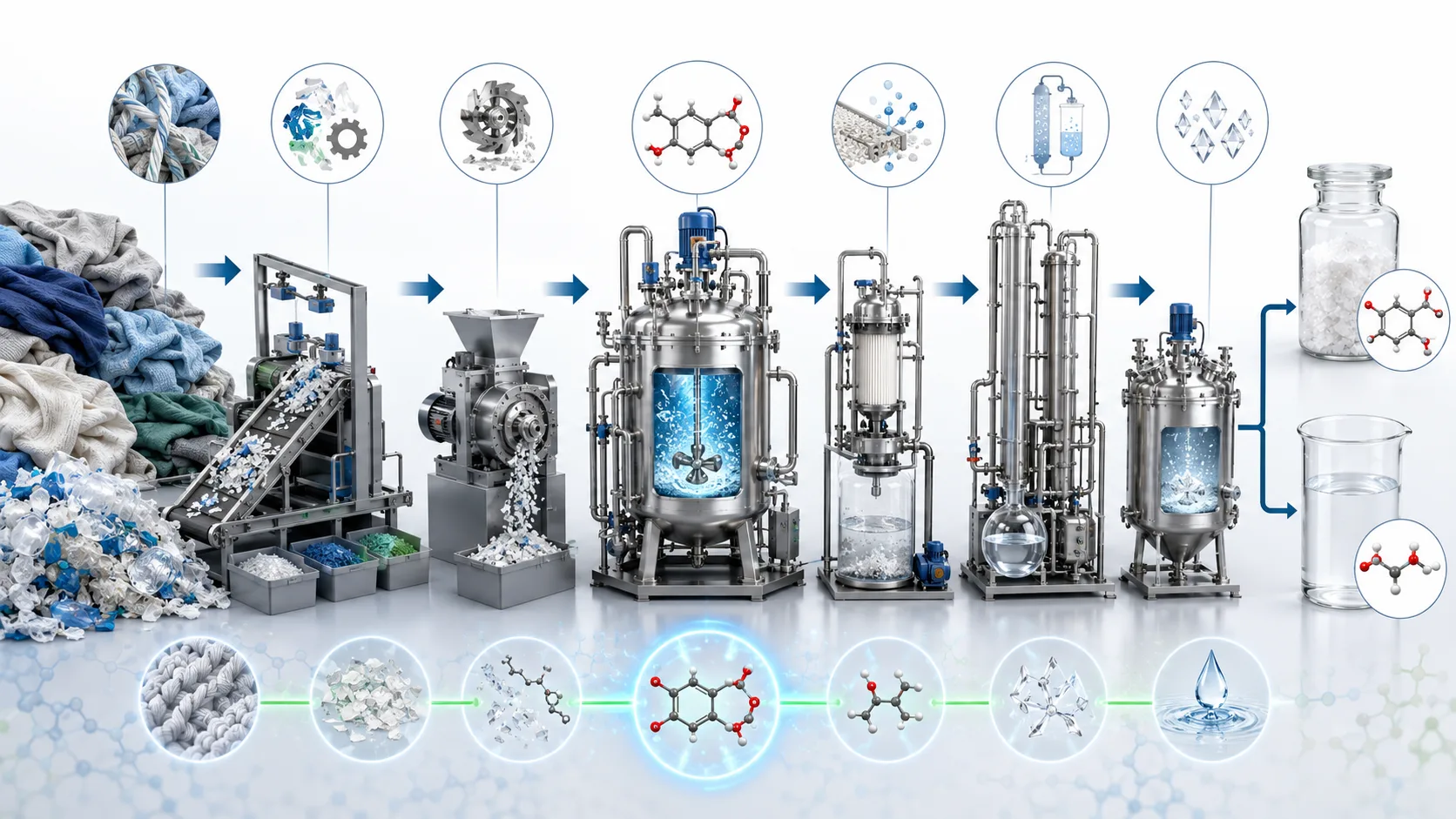
TL;DR
- Polyester fiber waste (waste polyester textiles) is a viable feedstock for chemical recycling — methanolysis depolymerization recovers DMT and ethylene glycol at purity ≥99.9%, equivalent to virgin-grade materials.
- Four-step process: pre-treatment → methanolysis depolymerization → DMT/EG separation and purification → full QC testing and delivery.
- Chemical recycling reduces CO₂ emissions by approximately 40-60% compared to petrochemical virgin routes and is eligible for ISCC PLUS Mass Balance certification.
- Keywords: chemical recycling polyester fiber · methanolysis DMT · chemical recycled DMT · low-carbon polyester raw material · waste polyester recycling
The Scale of Polyester Fiber Waste and the Case for Chemical Recycling
Polyester fiber (PET fiber, commonly known as polyester or "dacron") is the world's most produced synthetic fiber, with global output exceeding 70 million tonnes in 2025 — China accounts for over 65% of global production. Waste polyester fiber originates from multiple streams:
- Post-consumer textiles: end-of-life garments, home textiles, workwear, and industrial fabrics made from polyester
- Industrial fiber production waste: off-specification fiber, waste filament, yarn trimmings, and edge trim generated during manufacturing
- Waste PET articles: beverage bottles, industrial films, and other PET-based products (identical monomer chemistry to polyester fiber, fully suitable as DMT recycling feedstock)
Conventional mechanical recycling melts and reshapes waste polyester, but is limited to low-grade applications such as filler fiber or geotextiles. Repeated mechanical cycling causes progressive degradation of mechanical properties. Chemical recycling breaks ester bonds at the molecular level, depolymerizing polyester back to its monomers — DMT and ethylene glycol — whose quality is indistinguishable from virgin feedstock and suitable for all downstream polyester applications.
Chemical vs. Mechanical Recycling: Key Differences
| Dimension | Chemical Recycling | Mechanical Recycling |
|---|---|---|
| Product quality | Virgin-equivalent (purity ≥99.9%) | Inferior to virgin; contains contaminants |
| Feedstock tolerance | Blends, dyed, degraded material accepted | Requires relatively clean, single-material streams |
| Recyclability | Infinite cycles without property loss | Properties degrade with successive cycles |
| Downstream applications | All polyester end-uses (PBT / PET / PETG etc.) | Limited to low-value applications |
| CO₂ reduction | ~40-60% vs. petrochemical virgin route | ~15-20% vs. petrochemical virgin route |
| Technical complexity | High (requires precision separation/purification) | Low (physical melt process) |
Step-by-Step Chemical Recycling Process
ResourceCycle employs methanolysis (methanol-based depolymerization) to chemically recycle polyester waste. The process comprises four main stages:
Stage 1: Feedstock Pre-Treatment
Waste polyester must undergo rigorous pre-treatment before entering the reactor to remove contaminants that would impair depolymerization and downstream purity:
- Sorting and size reduction: Waste is roughly sorted by material type and color, then shredded to reactor-compatible particle size (1-5 mm)
- Decoloring and de-coating: Hot alkaline solution or organic solvent removes dyes, optical brighteners, and functional coatings
- Metal and foreign material removal: Magnetic separation + air classification removes metal fasteners, zippers, and non-polyester fiber components
- Moisture control: Drying to moisture content <0.5% to prevent unwanted hydrolysis side reactions
Pre-treatment quality directly determines the purity achievable in the final DMT and ethylene glycol products. A more thorough pre-treatment means lower purification energy requirements and fewer impurity-related process complications downstream.
Stage 2: Methanolysis Depolymerization
This is the core chemical recycling step. In the presence of a catalyst and methanol, at elevated temperature and pressure, ester bonds in the polyester chains are cleaved, yielding DMT and ethylene glycol:
- Reaction conditions: Temperature 160-250°C, pressure 0.5-3 MPa, catalyst system (alkaline catalyst or zinc salt)
- Conversion rate: ResourceCycle's proprietary high-efficiency solid base catalyst system achieves depolymerization conversion >99%; the catalyst is regenerable and recyclable
- Reactor design: Continuous stirred tank reactor (CSTR) combined with tubular reactor for uniform reaction and continuous production
- Methanol recovery: Excess methanol is condensed and recycled; overall methanol loss rate <2%
Stage 3: DMT and Ethylene Glycol Separation and Purification
The crude depolymerization liquor is processed through multiple separation and purification steps to yield polyester-grade DMT and ethylene glycol:
DMT Purification Route:
- Filtration to remove insoluble impurities and catalyst residues
- Low-temperature crystallization: DMT crystallizes out; colored impurities remain in the mother liquor
- Recrystallization: a second crystallization cycle further raises purity
- Vacuum sublimation or rectification: eliminates residual color bodies and trace impurities
- Final product: purity ≥99.9%, color (HAZEN) ≤5, meeting polyester-grade specification
Ethylene Glycol (EG) Purification Route:
- Distillation to separate ethylene glycol from methanol and water
- Activated carbon decolorization
- Rectification column for further purification
- Final product: EG purity ≥99.9%, UV transmittance meeting polyester-grade requirements
Stage 4: Quality Testing and Delivery
Every batch is fully tested against all specification parameters before shipment. Standard deliverables include a Certificate of Analysis (COA) and Safety Data Sheet (MSDS / SDS):
| Parameter | Polyester-Grade Industry Standard | ResourceCycle Typical Value |
|---|---|---|
| DMT purity | ≥99.5% | ≥99.9% |
| Color (HAZEN) | ≤10 | ≤5 |
| Acid value (mgKOH/g) | ≤0.01 | <0.005 |
| Fe ion content (ppm) | ≤1 | <0.5 |
| Ash content (%) | ≤0.005 | <0.003 |
| Moisture (%) | ≤0.1 | <0.05 |
Downstream Applications of Chemically Recycled DMT
High-purity DMT produced via chemical recycling is a direct drop-in replacement for virgin DMT across all downstream applications:
- PBT engineering plastics: EV connectors, charging infrastructure, 5G base station components, precision electronics
- PETG / PCTG copolyesters: premium packaging, food-contact materials, cosmetic bottles, baby products
- PCT engineering plastics: medical devices, high-temperature electrical components, optical applications
- Polyester resins and polyols: industrial coatings, appliance coatings, coil coatings, powder coating polyester polyols
- PBAT biodegradable plastics: compostable film bags, agricultural mulch film, biodegradable packaging
Carbon Footprint and Sustainability Certification
Chemical recycling delivers significant carbon advantages over petrochemical virgin production:
- CO₂ emissions reduced by approximately 40-60% (full lifecycle LCA basis)
- Eligible for ISCC PLUS Mass Balance certification
- Compliant with ISO 14067 carbon footprint accounting
- Enables downstream brands to claim verified Scope 3 emission reductions with traceable documentation
- Supports compliance with EU CSRD, REACH, and EPD (Environmental Product Declaration) frameworks
ResourceCycle's Chemical Recycling Production Capacity
ResourceCycle (Hangzhou) New Materials employs proprietary chemical recycling technology at its Huanggang production base:
- Annual capacity: High-purity DMT 5,000 t/year + ethylene glycol 1,600 t/year
- Feedstock flexibility: Processes waste polyester fiber, waste PET bottles, and industrial polyester scrap from multiple source streams
- Batch consistency: Purity variation between batches <0.05%; stable color specification
- Documentation: Standard COA and MSDS delivery; ISCC PLUS Mass Balance traceability; full export documentation support
Frequently Asked Questions
Q1: Is chemically recycled DMT performance-equivalent to virgin DMT?
Yes — when process controls are in place, chemically recycled DMT is specification-identical to virgin DMT across all key parameters (purity, color, acid value, Fe content). ResourceCycle provides polyester-grade DMT at purity ≥99.9%. Customers are welcome to request product samples for independent verification testing; third-party COA reports are available for direct comparison.
Q2: What sustainability documentation is available for recycled DMT?
ResourceCycle supplies ISCC PLUS Mass Balance certificates, COAs with full analytical data, and ISO 14067-based carbon footprint reports. This documentation package meets the green supply chain management requirements of brand owners, and supports EU CSRD disclosures and EPD declarations.
Q3: What are the MOQ and lead times?
Minimum order quantity for DMT is 1 tonne; sample quantities are available for evaluation. Bulk procurement can be structured under framework agreements with scheduled delivery. Contact the ResourceCycle sales team for current pricing, availability, and lead time confirmation.
Conclusion
Chemical recycling of polyester fiber waste is the most technically rigorous and commercially scalable route toward a true closed-loop polyester economy. The process — from waste polyester textiles through methanolysis to high-purity DMT and ethylene glycol — simultaneously addresses end-of-life textile waste disposal and provides low-carbon, traceable, virgin-equivalent raw materials to PBT, PETG, coating resin, and specialty polyester manufacturers. ResourceCycle is committed to deepening its proprietary chemical recycling capabilities to deliver stable, high-quality polyester-grade DMT and EG supply to customers worldwide.
Related articles
- 01Technology
Chemical Recycling of Polyester Fiber Waste: From Waste Polyester to High-Purity DMT and Ethylene Glycol
ResourceCycle explains the four-step chemical recycling process for polyester fiber (polyester textile) waste — pre-treatment, methanolysis depolymerization, DMT and ethylene glycol separation — producing polyester-grade raw materials with purity ≥99.9% from discarded textiles.
Read more 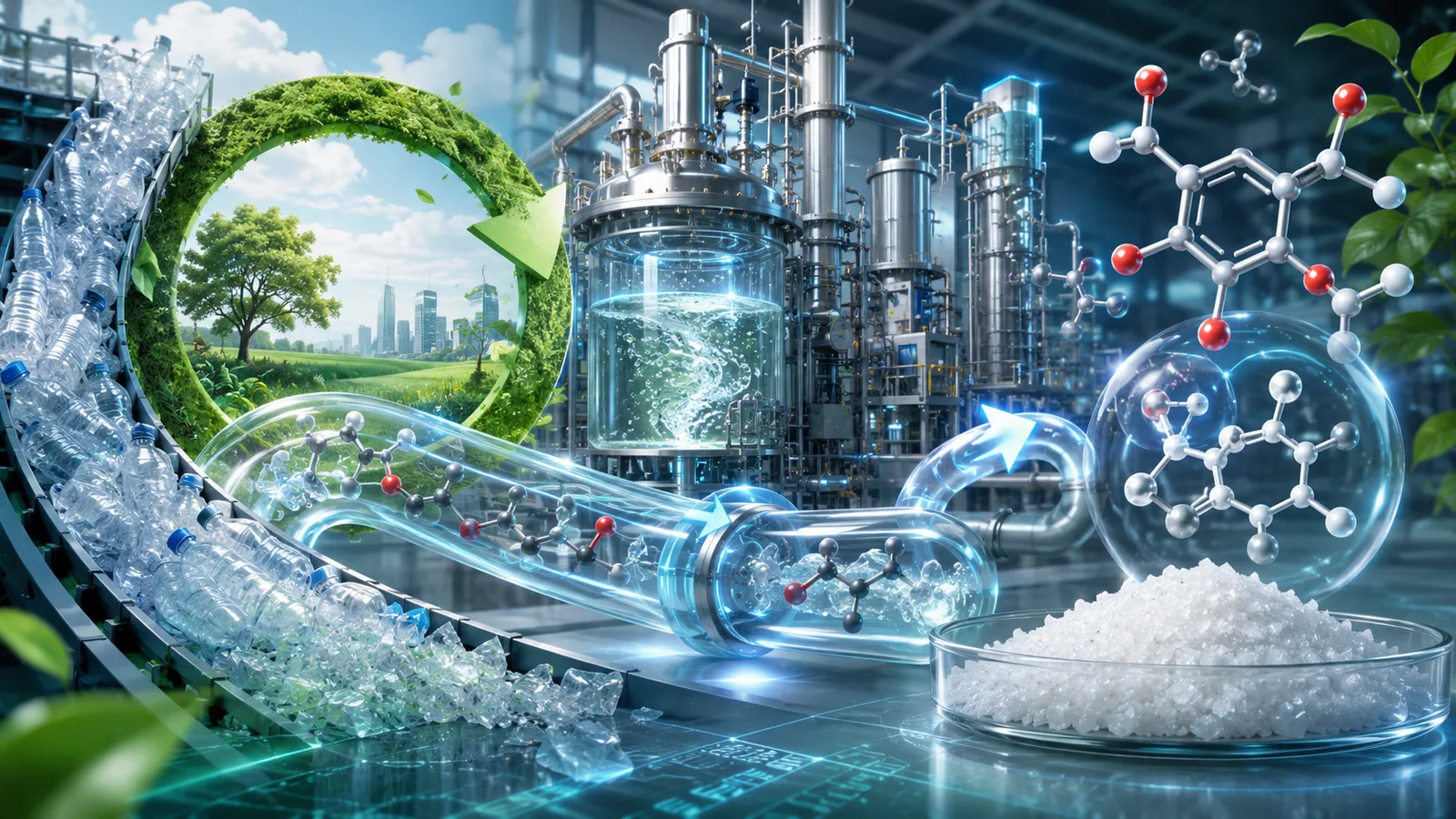 02Technology
Low-Temperature Atmospheric Methanolysis of PET to Polymer-Grade DMT: ResourceCycle's New-Quality-Productivity Process Breakthrough
ResourceCycle and the Zhejiang University Green Carbon Joint Research Center have developed a disruptive process that completes PET chemical depolymerisation at 64.5 °C atmospheric reflux — achieving 99.2% PET conversion, 99.5% DMT selectivity, 99.75% product purity, 60%+ capex reduction, 45-50% energy savings, with kiloton-per-year commercial operation.
Read more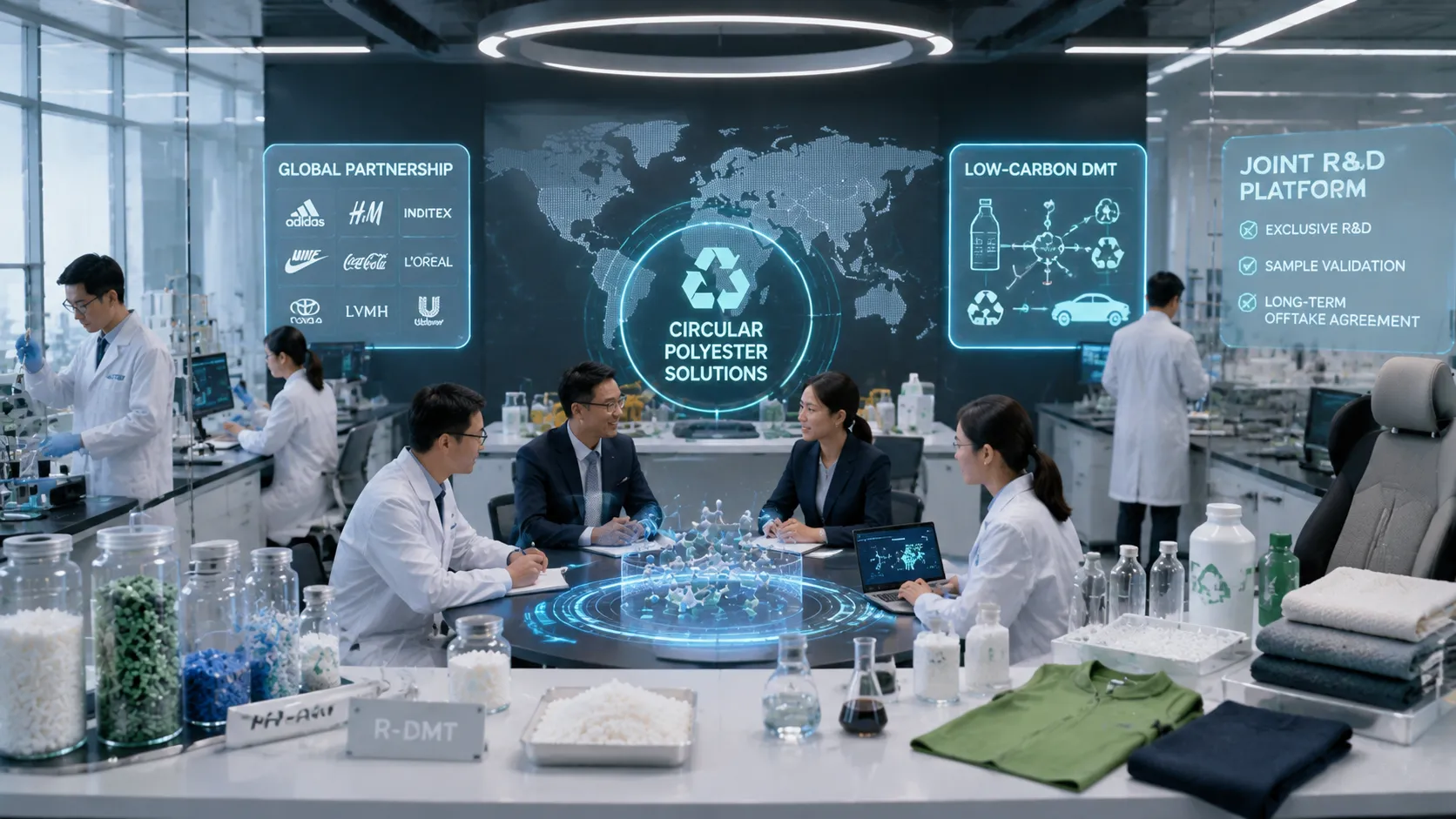 03Technology
ResourceCycle as a Low-Carbon DMT Co-Development Platform for Global Closed-Loop Polyester Partnerships
Global brands are moving material decisions upstream to the polyester monomer level. With high-purity DMT production, methanolysis R&D and closed-loop material platform capabilities, ResourceCycle is positioned for exclusive joint development programs and long-term pre-purchase agreements.
Read more