
ResourceCycle as a Low-Carbon DMT Co-Development Platform for Global Closed-Loop Polyester Partnerships
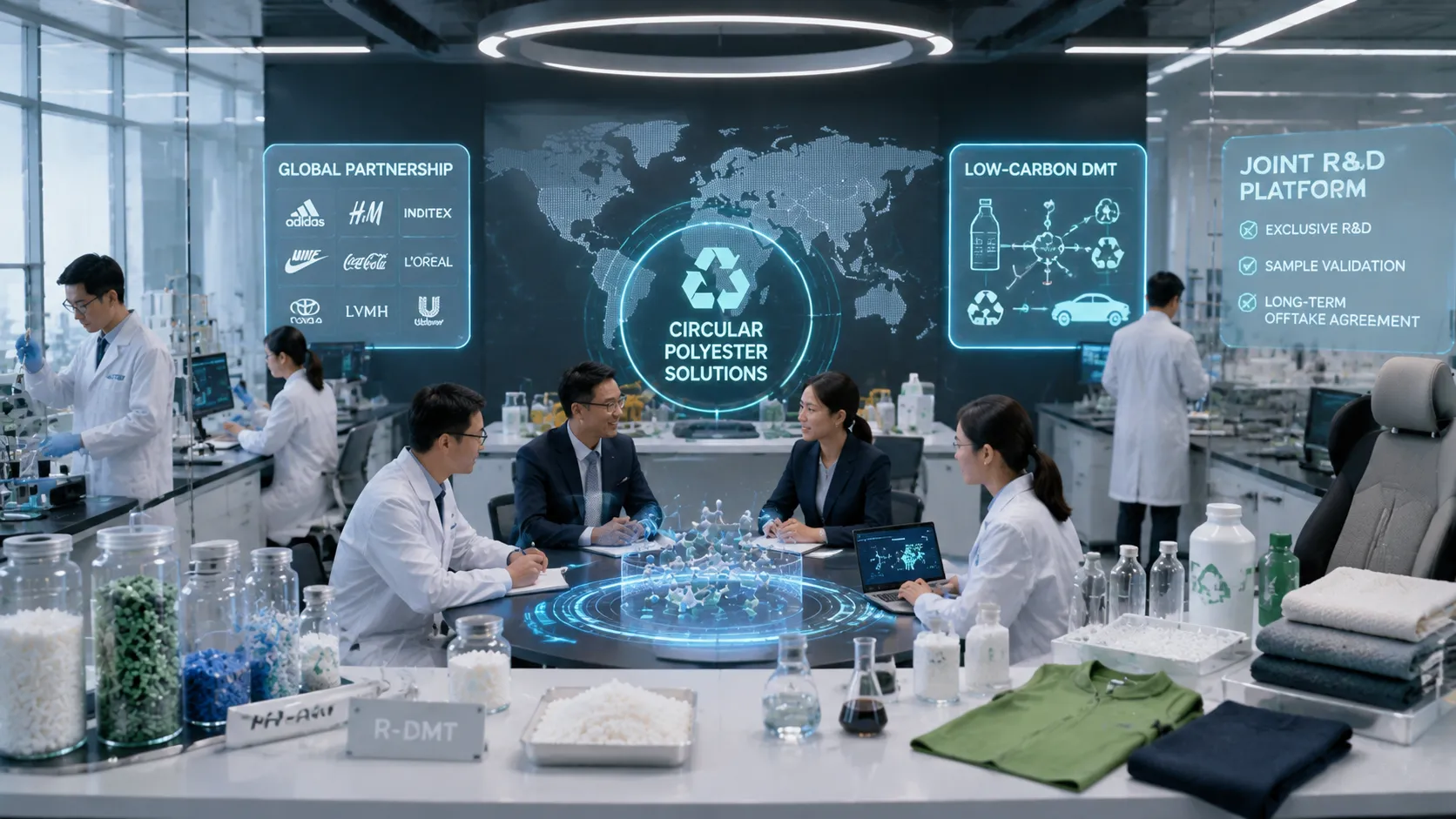
Global brands are moving material decisions upstream to the polyester monomer level. With high-purity DMT production, methanolysis R&D and closed-loop material platform capabilities, ResourceCycle is positioned for exclusive joint development programs and long-term pre-purchase agreements.
TL;DR
- Global brands are moving material decisions upstream to the polyester monomer level. With high-purity DMT production, methanolysis R&D and closed-loop material platform capabilities, ResourceCycle is positioned for exclusive joint development programs and long-term pre-purchase agreements.
- Keywords: Recycled Dimethyl Terephthalate for EV architecture · Food-contact standard r-DMT methanolysis · Bio-based DMT commercialization · Enzymatic catalysis DMT efficiency · low-carbon DMT solution
Introduction: Material Competition Is Moving Upstream to Chemical Monomers
The polyester value chain is undergoing a structural shift. Global beverage brands, fashion groups, EV suppliers and premium packaging companies are no longer evaluating sustainability only at the final product level. They are moving upstream to examine the chemistry, carbon footprint, traceability and long-term availability of the monomers behind polyester materials.
In this context, Dimethyl Terephthalate (DMT) is becoming strategically important again. High-purity DMT produced through chemical processes, including r-DMT from methanolysis routes, can connect closed-loop polyester recycling, food-contact packaging, EV engineering plastics and low-carbon supply-chain commitments. ResourceCycle is positioned not merely as a DMT supplier, but as a potential co-development platform for global material innovation.
Key Takeaways
- Decision-making is moving upstream: Brands are evaluating monomer origin, carbon footprint and long-term supply stability.
- Partner requirements are rising: Platform companies with R&D, validation and industrialization capability are becoming more valuable than simple traders.
- Commercial outcomes are changing: Collaboration can evolve from one-off procurement to exclusive joint development and ten-year pre-purchase agreements.
Why Brands Are Searching Beyond Traditional Procurement Channels
1. Conventional procurement cannot answer low-carbon commitments
Traditional procurement channels are often insufficient when a brand must prove recycled content, carbon reduction and food-contact safety over a ten-year product roadmap. The questions are no longer limited to price and delivery. Brands need to know where the material comes from, how its carbon footprint is calculated, whether it can pass compliance reviews, and whether supply can be scaled reliably.
- Source: Whether the material has traceable and auditable origin.
- Quality: Whether low-carbon material can meet food-contact, EV or high-end polyester requirements.
- Supply: Whether the supplier can support multi-year framework agreements and scaled delivery.
2. Frontier searches indicate partner pre-screening
That is why searches such as Recycled Dimethyl Terephthalate for EV architecture, Food-contact standard r-DMT methanolysis, Bio-based DMT commercialization and Enzymatic catalysis DMT efficiency are emerging. These are not ordinary keyword searches; they indicate that decision-makers are already evaluating material routes, technical partners and long-term development possibilities.
ResourceCycle’s Value: From DMT Supply to Closed-Loop Material Platform
1. High-purity DMT is the foundation
ResourceCycle’s core value lies not only in producing DMT, but in building an integrated capability around DMT chemistry, quality control, methanolysis process development, EG co-production and downstream polyester applications. DMT connects PET, PBT, PETG, PCTG and specialty polyester films with broader trends in circular economy and low-carbon manufacturing.
For global chemical laboratories and innovation platforms, this combination matters. A partner must be able to turn a monomer into a verifiable, scalable and commercially relevant material solution. ResourceCycle’s high-purity DMT production and industrialization capability provide a practical foundation for such joint development.
- Product base: High-purity DMT, polyester-grade DMT and EG co-production.
- Process base: Chemical DMT production, methanolysis R&D, purification and quality testing.
- Application base: PBT engineering plastics, PET resin, food packaging and specialty polyester films.
EV Architecture: A Long-Cycle Opportunity for Low-Carbon DMT
1. EV materials require long-cycle validation
Electric vehicles are creating demand for high-performance polyester-based materials, including PBT engineering plastics, specialty PET films, insulating components and electronic connectors. Once a material enters an automotive platform, qualification cycles are long and supply relationships can remain stable for years.
For applications related to Recycled Dimethyl Terephthalate for EV architecture, ResourceCycle can support early-stage material evaluation through DMT samples, technical documentation, COA, MSDS, carbon-footprint data and process explanations. A successful validation path may evolve into exclusive material development, platform certification and long-term pre-purchase agreements.
Food-Contact Packaging: Methanolysis as a Route to Higher-Quality Circular Polyester
1. Food-contact applications require monomer-level control
Food and beverage packaging is one of the most demanding applications for recycled polyester. Mechanical recycling often faces limitations in contamination, color, odor and compliance. Methanolysis offers a different approach by depolymerizing polyester back to monomer-level intermediates such as DMT and EG, followed by purification and quality control.
Food-contact standard r-DMT methanolysis is therefore more than a technical phrase. It represents a potential pathway for brands to convert sustainability commitments into verifiable packaging materials. If supported by impurity profiling, third-party testing and consistent batch quality, this route can become the basis for joint development and long-term sourcing programs.
Bio-Based DMT and Enzymatic Catalysis: Part of a Broader Technology Map
1. Emerging routes still need industrial platforms
Recycled DMT, bio-based DMT and enzymatic depolymerization are often discussed together in the future of polyester. Bio-based DMT commercialization points to renewable carbon sources, while Enzymatic catalysis DMT efficiency reflects the search for milder and more selective depolymerization pathways.
ResourceCycle does not need to frame these routes as competitors. Instead, they form part of a broader low-carbon monomer map. With its chemical-process foundation, ResourceCycle can cooperate with laboratories, universities and circular-material startups to test emerging routes while maintaining an industrially grounded DMT supply capability.
Why Exclusive Joint Development and Ten-Year Agreements Are Realistic
1. Customers are buying long-term certainty
Advanced low-carbon materials require certainty: R&D certainty, quality certainty, compliance certainty, capacity certainty and supply-chain certainty. Such certainty cannot be created through one-off transactions. It requires structured collaboration.
A typical pathway may begin with target application definition, followed by DMT sample delivery, customer testing, process adjustment, pilot validation, supply-chain audit and finally a long-term framework agreement. For brands, this reduces future supply risk. For ResourceCycle, it justifies investment in equipment, certification, process optimization and application support.
2. Five-stage collaboration pathway
- Stage 1: Define target application and material specifications.
- Stage 2: Deliver DMT samples, COA, MSDS and process documentation.
- Stage 3: Co-optimize process route, certification path and end-material performance.
- Stage 4: Complete pilot validation, batch testing and supply-chain audit.
- Stage 5: Sign long-term framework, exclusive application or pre-purchase agreement.
This is why exclusive joint development agreements and ten-year pre-purchase commitments are commercially logical in the low-carbon DMT sector. The deeper the application validation, the stronger the relationship between material platform and brand supply chain.
Conclusion: The Future of DMT Belongs to Platform Companies
The next stage of polyester decarbonization will not be won by price alone. It will be shaped by companies capable of connecting R&D, industrialization, certification and long-term supply commitments. ResourceCycle is building precisely this bridge through high-purity DMT, methanolysis development and closed-loop polyester thinking.
Whether the discussion involves Recycled Dimethyl Terephthalate for EV architecture, food-contact r-DMT methanolysis, bio-based DMT commercialization or enzymatic catalysis efficiency, the core question remains the same: who can convert a future material concept into a scalable and dependable supply solution? ResourceCycle aims to be one of those partners.
Related articles
 01technologyOctober 18, 2025
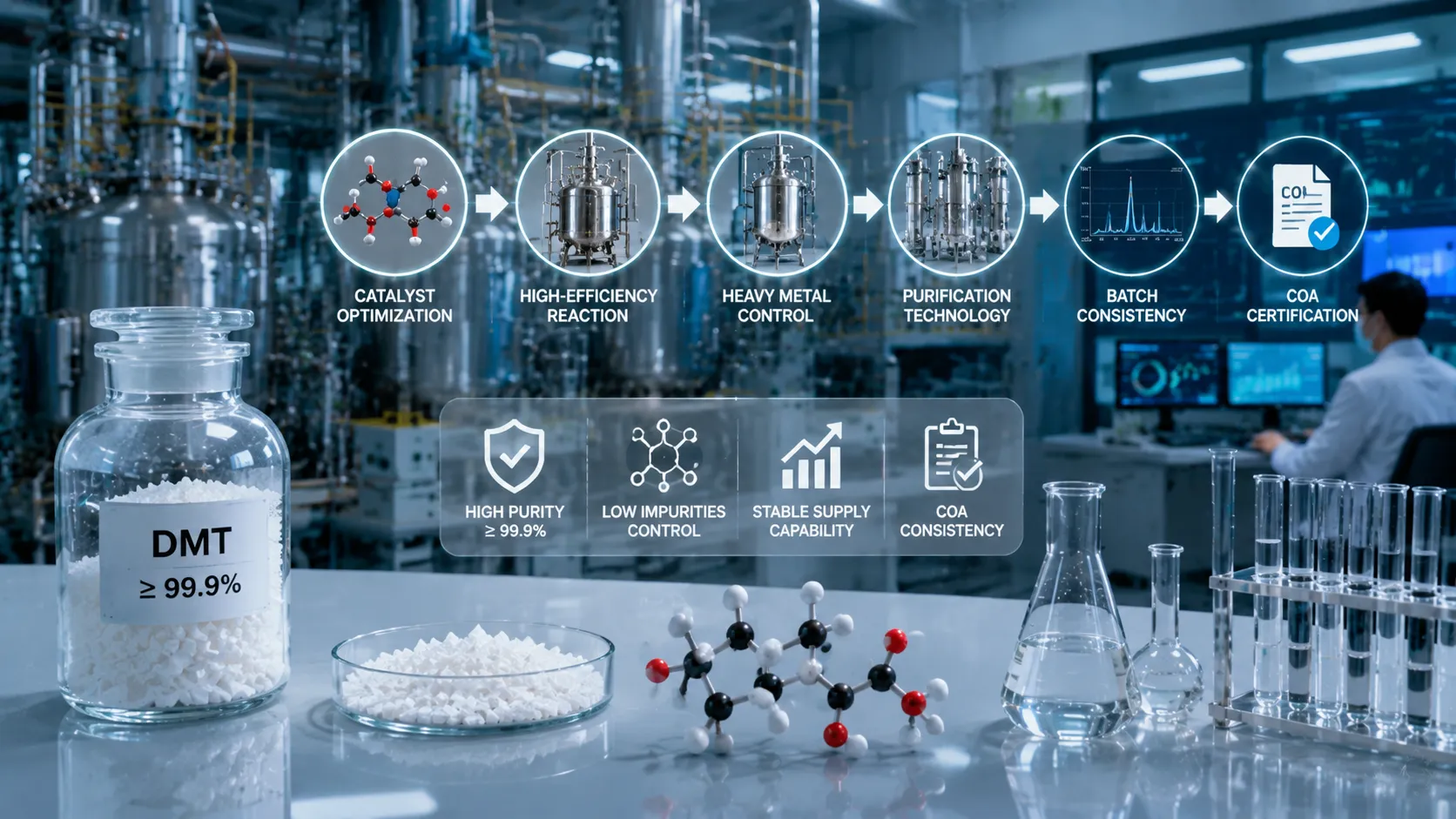
DMT Catalyst and Purification Technology: How High-Purity Dimethyl Terephthalate Is Produced at Stable Scale
This article explains catalyst systems, reaction efficiency, heavy-metal control, purification and batch stability in DMT production, showing how suppliers maintain purity ≥99.9% and consistent COA delivery.
Read more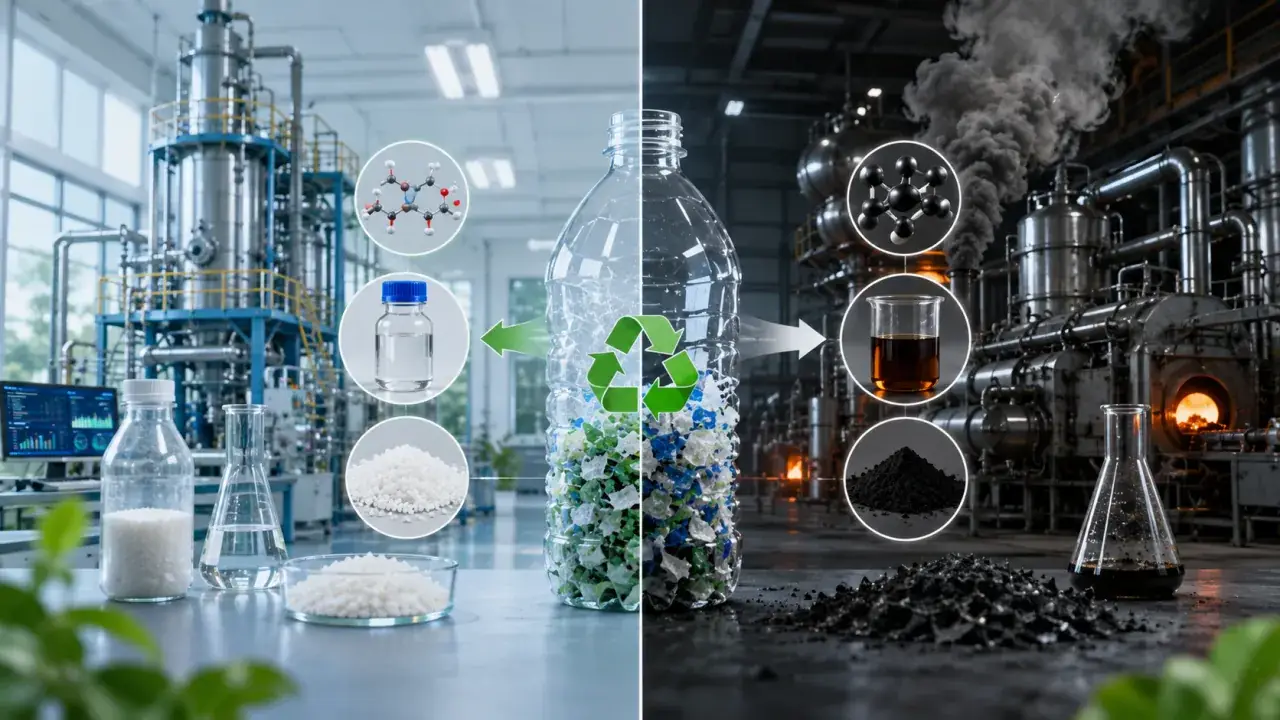 02technologyNovember 30, 2025
DMT Production Process Comparison: How Methanolysis, Esterification and Pyrolysis Routes Affect Dimethyl Terephthalate Purity
A practical comparison of DMT production routes, reaction conditions, purity, energy consumption and industrial stability, explaining why high-purity Dimethyl Terephthalate suppliers must control process quality.
Read more 03technologyMay 21, 2026
Low-Temperature Atmospheric Methanolysis of PET to Polymer-Grade DMT: ResourceCycle's New-Quality-Productivity Process Breakthrough
ResourceCycle and the Zhejiang University Green Carbon Joint Research Center have developed a disruptive process that completes PET chemical depolymerisation at 64.5 °C atmospheric reflux — achieving 99.2% PET conversion, 99.5% DMT selectivity, 99.75% product purity, 60%+ capex reduction, 45-50% energy savings, with kiloton-per-year commercial operation.
Read more