
In-Depth Analysis of Dimethyl Terephthalate (DMT): The Core Driver of the Modern High-Value-Added Polyester Industry
This article provides an in-depth analysis of DMT, comparing its process differences with PTA, and detailing its irreplaceability in high-value-added application fields with high purity and optical requirements, such as PBT, special PET films, and medical-grade PETG.
TL;DR
- This article provides an in-depth analysis of DMT, comparing its process differences with PTA, and detailing its irreplaceability in high-value-added application fields with high purity and optical requirements, such as PBT, special PET films, and medical-grade PETG.
- Keywords: DMT · Dimethyl Terephthalate · high-value polyester · PBT · PETG
1. Core Definition: Chemical Identity and Industry Chain Position of DMT
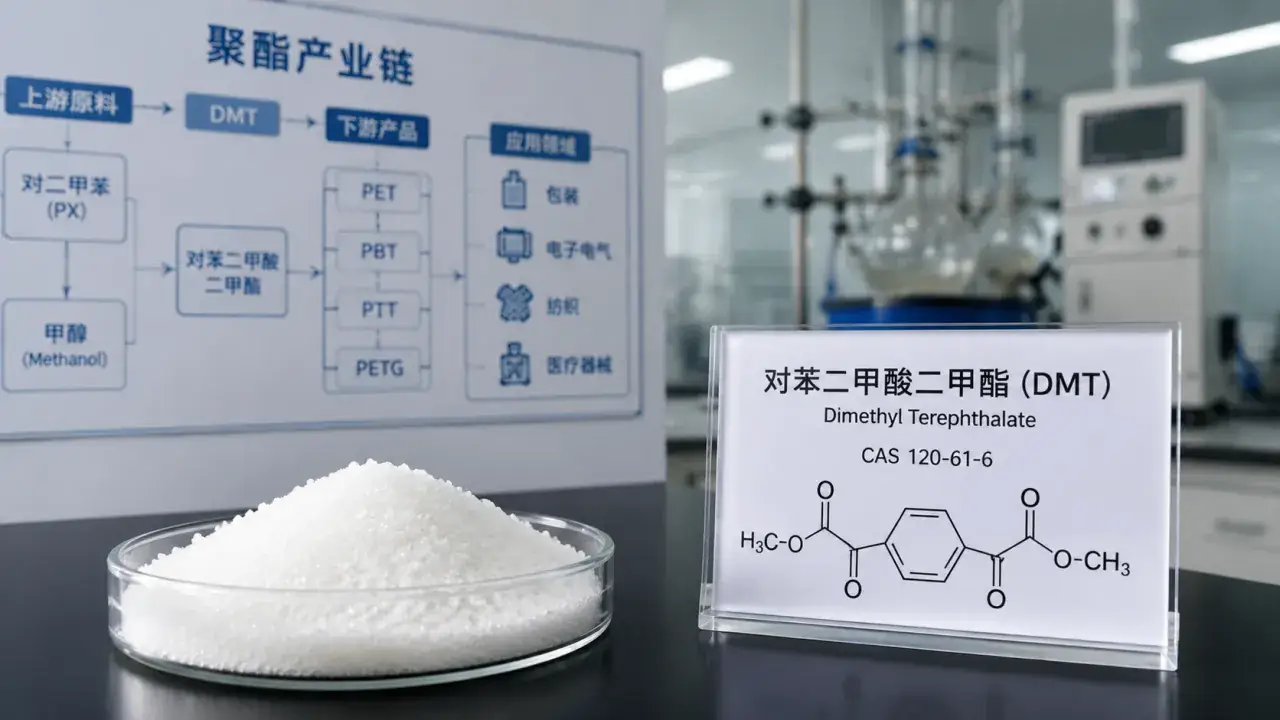
Dimethyl terephthalate (industrially referred to as DMT, CAS Number: 120-61-6) is one of the most core basic monomers in the modern polyester industry. Structurally, it is the dimethyl ester derivative of terephthalic acid, usually appearing as white crystalline powder or flakes at room temperature.
In the macro industry chain, DMT plays a crucial connecting role. Its upstream connects to basic petrochemical products (such as para-xylene and methanol), while its downstream points directly to several extremely important polymer materials, primarily including:
- PET (Polyethylene Terephthalate): Widely used in beverage packaging, high-end films, and specialty textiles.
- PBT (Polybutylene Terephthalate): High-performance engineering plastics dominating electrical insulation and automotive electronics.
- PTT (Polytrimethylene Terephthalate): Specialty fiber materials with excellent resilience.
- PETG (Copolyester): Highly transparent and tough specialty modified polyesters, widely used in medical and high-end packaging.
Although its market share in general commodity textiles has been historically challenged by other routes, DMT remains the core leader in specialty materials demanding high purity, high optical requirements, and uniform molecular structure.
Ruisaike perspective: Ruisaike specializes in high-purity Dimethyl Terephthalate (DMT) production through chemical process technology, with product purity of ≥99.9% for polyester-grade applications. For customers in PBT, PET resin, PETG copolyester and specialty polyester films, Ruisaike provides not only DMT supply, but also COA documentation, MSDS safety data and sample validation support.
2. Technical Comparison: Three Core Advantages of DMT over PTA
In industrial practice and plant design, the choice of raw materials often determines the process direction and product quality limit. There are two main technical routes for polyester synthesis: the transesterification route using DMT, and the direct esterification route using purified terephthalic acid (PTA). For specific high-value-added materials, DMT has significant and irreplaceable advantages in the following three physical and chemical properties:
1. Easy Handling of By-Products Ensuring Catalyst Activity
- DMT Route (Transesterification): When DMT reacts with diols, the by-product released is methanol. In industrial plants, methanol is easily extracted and recycled through distillation towers. This mild separation process does not disrupt the chemical equilibrium in the reactor.
- PTA Route (Direct Esterification): PTA reacts directly with diols, producing water as a by-product. At high temperatures, steam is not only difficult to extract completely, but it also causes certain water-sensitive specialty catalysts (such as titanium-based catalysts) to hydrolyze and deactivate, significantly reducing the conversion rate.
2. Extremely High Purification Limit Achieving Ultimate Optical Purity
- Purification Advantage of DMT: Due to its distinct and relatively low melting and boiling points, DMT is extremely suitable for deep purification through vacuum distillation or multiple crystallization processes. Industrial-grade DMT purified through multi-stage distillation can easily achieve a purity of 99.9% or higher.
- Purification Bottleneck of PTA: Conversely, PTA has an extremely high melting point, sublimates directly when heated, and is extremely difficult to dissolve in most conventional solvents, making its purification highly energy-intensive and challenging.
Ruisaike execution capability: The advantages of the DMT route are meaningful only when supported by stable batch quality. Ruisaike focuses on key indicators such as purity, color, acid value, ash and moisture to help downstream customers reduce risks in trial failure, color fluctuation and polymerization instability.
3. Excellent System Solubility Ensuring Highly Uniform Liquid-Phase Reactions
- Homogeneous Reaction of DMT: DMT is highly soluble in common diols at elevated temperatures. This homogeneous reaction ensures that polymers synthesized have a very narrow molecular weight distribution and highly consistent structure.
- Heterogeneous Reaction of PTA: PTA is poorly soluble in diols, often presenting as a "solid-liquid" slurry mixture in the initial reaction stage, easily leading to side reactions.
3. Terminal Scenarios: Three Irreplaceable Application Fields Dominated by DMT
1. PBT Engineering Plastics: Solid Barriers for Automotive Electronics and Fiber Optic Communications
When producing PBT (polybutylene terephthalate), the high solubility of DMT in butanediol guarantees a perfect liquid-phase homogeneous reaction. The PBT homopolymers produced using DMT have excellent batch-to-batch performance consistency, perfectly meeting the insulation requirements of over 150°C high temperatures, and are widely used in electronic connectors under automotive hoods, high-voltage wiring harness sheaths of new energy vehicles, and loose tubes of deep-sea optical fibers.
Relevance to Ruisaike products: PBT customers typically focus on DMT purity, acid value, moisture and delivery stability. Ruisaike can provide polyester-grade DMT samples, batch quality documents and customized supply solutions for PBT engineering plastic customers during lab trials, pilot validation and commercial introduction.
2. Specialty Polyester Films: Solving the "Carboxyl Residue" Pain Point to Challenge Optical Limits
In incomplete direct esterification, the ends of PTA polymer chains often retain unreacted carboxyl groups, which can easily trigger thermal-oxidative degradation leading to film yellowing. The DMT route fundamentally avoids this problem. Specialty PET films synthesized via DMT transesterification have almost no carboxyl residues, easily meeting the strict requirements of optical display modules for a light transmittance greater than 90%.
3. PETG Copolyester: The Preferred Precursor for Medical-Grade Packaging Materials
Medical device packaging materials must withstand rigorous sterilization processes without yellowing or becoming brittle. Synthesizing PETG requires ensuring the comonomers are absolutely randomly distributed to destroy the crystallization capability. The transesterification reaction rate of DMT is mild and highly controllable, making it the undisputed preferred precursor for synthesizing non-toxic, highly transparent, and radiation-sterilization-resistant top-tier medical packaging.
Supply chain recommendation: For premium PETG, specialty PET film and medical packaging manufacturers, DMT supplier screening should include product indicators, COA, MSDS, sample batch consistency and long-term supply capability. Ruisaike can support sample testing, process matching and long-term framework cooperation based on its high-purity DMT production capability.
4. Conclusion and Actionable Advice
In high-value-added tracks such as PBT engineering plastics, specialty polyester films, and high-end medical-grade PETG, DMT continues to play an irreplaceable key role by virtue of its three core advantages: mild by-products, extremely high purity, and excellent system solubility. For quality control in related supply chains, we recommend explicitly including "whether the base material is synthesized via the DMT route" and "carboxyl end group (CEG) content indicators" in the key evaluation dimensions to mitigate reliability risks from the source.
For Ruisaike, the long-term value of DMT is not limited to single-product sales. It lies in entering higher-value polyester supply chains through stable chemical-process production, polyester-grade quality control and technical collaboration with downstream applications. Ruisaike will continue strengthening its capabilities around high-purity DMT, PBT raw material DMT, PET resin DMT monomer and specialty polyester applications.

Related articles
 01technologyOctober 18, 2025
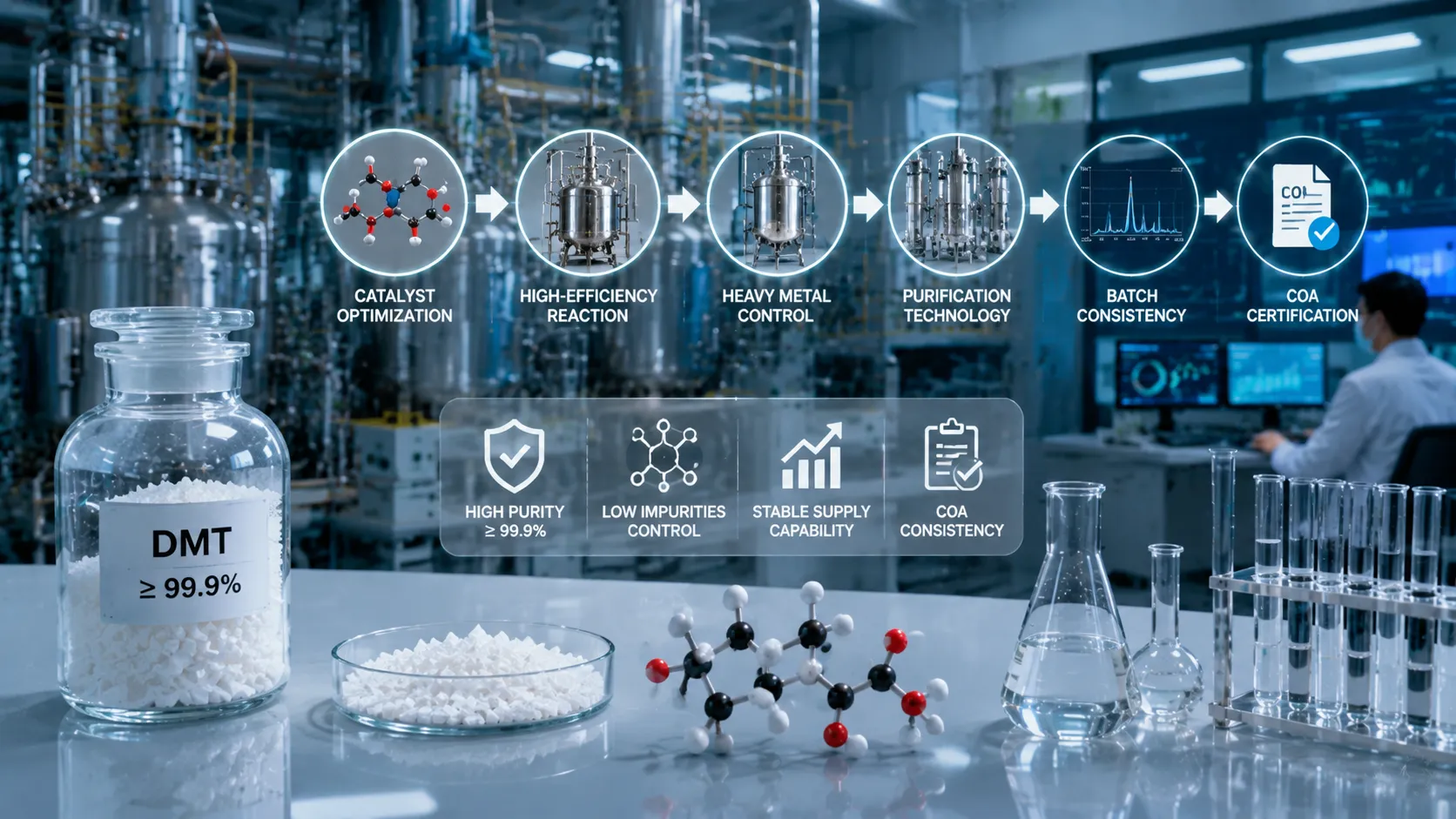
DMT Catalyst and Purification Technology: How High-Purity Dimethyl Terephthalate Is Produced at Stable Scale
This article explains catalyst systems, reaction efficiency, heavy-metal control, purification and batch stability in DMT production, showing how suppliers maintain purity ≥99.9% and consistent COA delivery.
Read more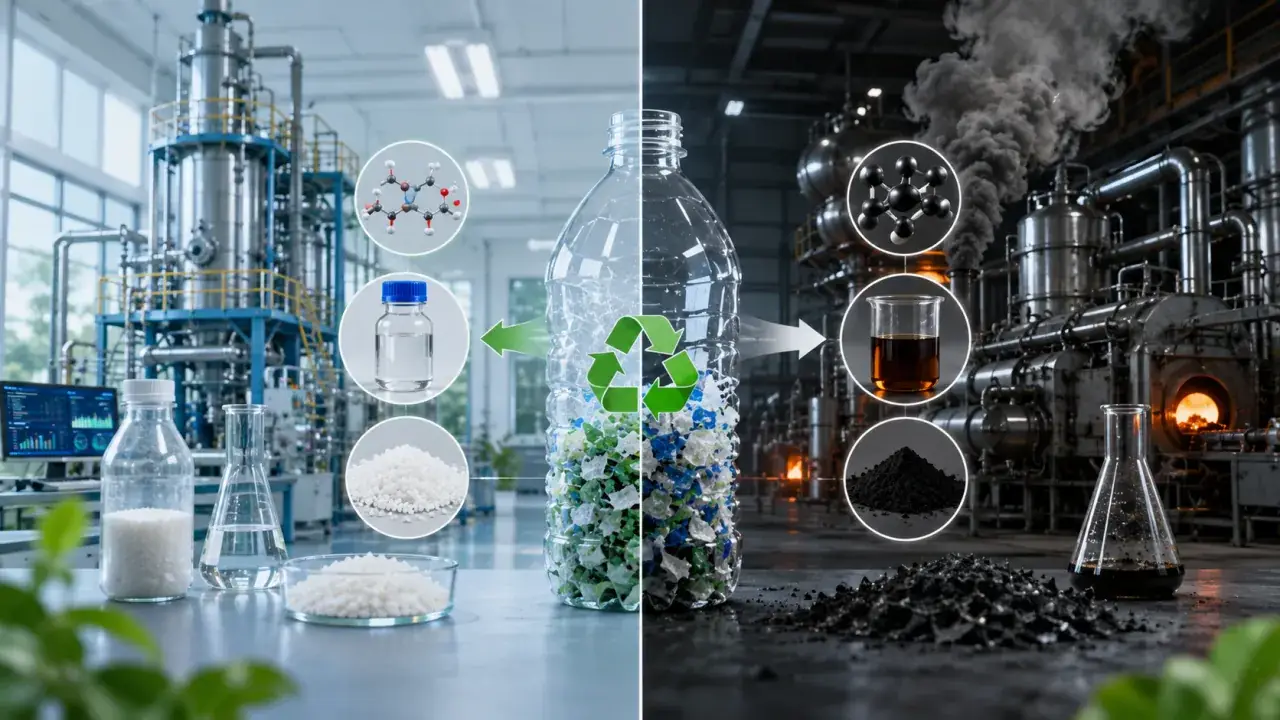 02technologyNovember 30, 2025
DMT Production Process Comparison: How Methanolysis, Esterification and Pyrolysis Routes Affect Dimethyl Terephthalate Purity
A practical comparison of DMT production routes, reaction conditions, purity, energy consumption and industrial stability, explaining why high-purity Dimethyl Terephthalate suppliers must control process quality.
Read more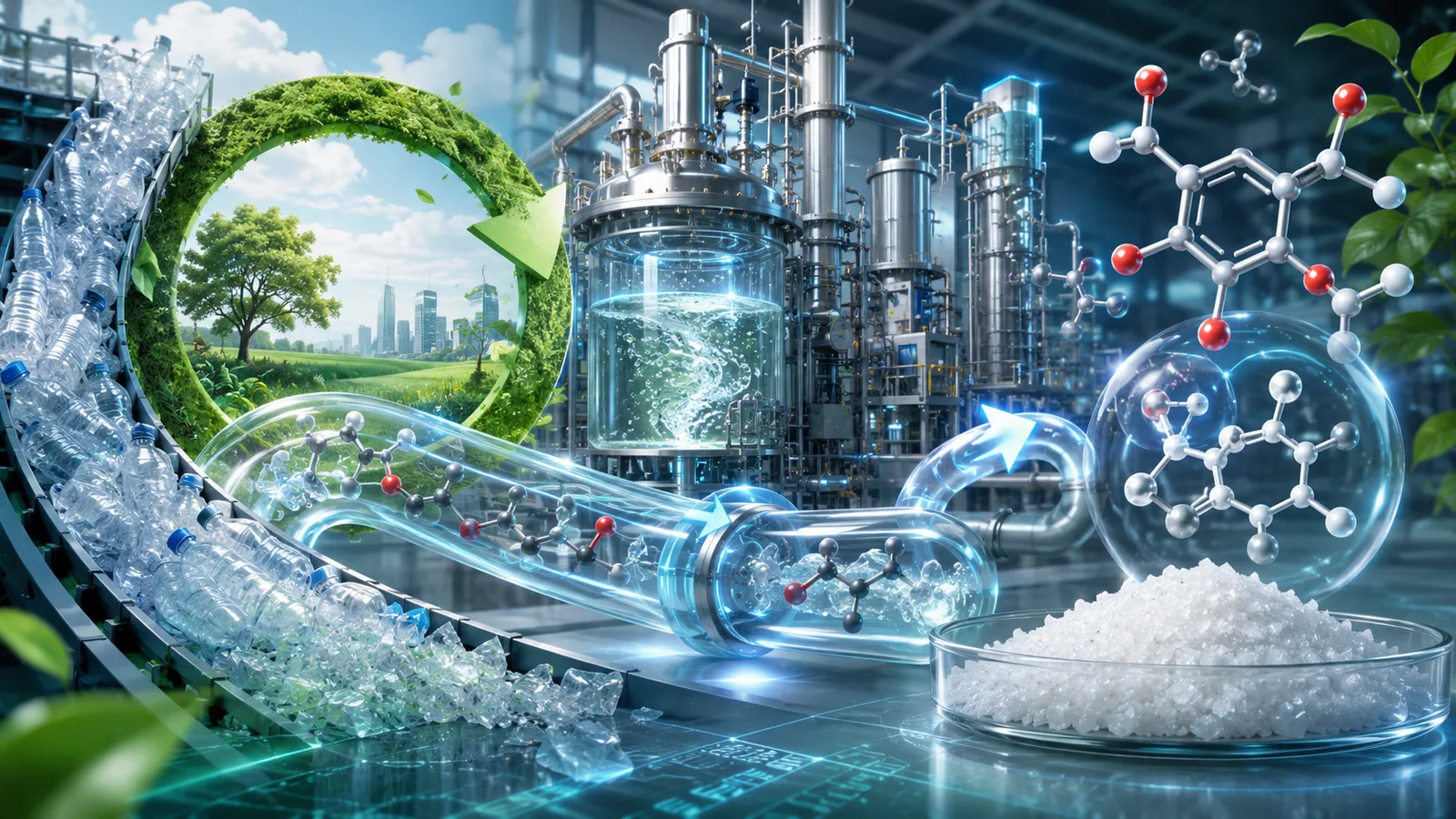 03technologyMay 21, 2026
Low-Temperature Atmospheric Methanolysis of PET to Polymer-Grade DMT: ResourceCycle's New-Quality-Productivity Process Breakthrough
ResourceCycle and the Zhejiang University Green Carbon Joint Research Center have developed a disruptive process that completes PET chemical depolymerisation at 64.5 °C atmospheric reflux — achieving 99.2% PET conversion, 99.5% DMT selectivity, 99.75% product purity, 60%+ capex reduction, 45-50% energy savings, with kiloton-per-year commercial operation.
Read more