
2026 Global Supply Chain Reshaping: DMT Market Outlook, Price Trends & China Sourcing Strategy
An in-depth analysis of the 2026 DMT global supply-demand landscape transformation — from macro market outlook, PX-DMT cost transmission mechanisms, and PTA substitution dynamics to China's integrated advantages and low-cost sourcing strategies, providing supply chain executives with a strategic and actionable intelligence guide.

TL;DR
- An in-depth analysis of the 2026 DMT global supply-demand landscape transformation — from macro market outlook, PX-DMT cost transmission mechanisms, and PTA substitution dynamics to China's integrated advantages and low-cost sourcing strategies, providing supply chain executives with a strategic and actionable intelligence guide.
- Keywords: DMT market · global supply chain · price trends · PTA substitution · China sourcing
Introduction: Breaking Through Supply Chain Disruptions Amid Macro Turbulence
Against the backdrop of escalating geopolitical rivalry and global energy transition, the volatility of basic and specialty chemical markets is growing exponentially. Dimethyl terephthalate (DMT) — an indispensable core intermediate in the polyester value chain — stands at the crossroads of a new round of global capacity restructuring. For supply chain executives, Chief Procurement Officers (CPOs), and market analysts at multinational corporations, finding certainty in uncertain cycles has become the central determinant of profitability and survival.
This article is grounded in an in-depth Global supply chain analysis, providing a comprehensive dissection of the DMT market landscape for 2026 and beyond. We examine macro market dynamics, upstream cost transmission mechanisms, substitute competition, and China's structural advantages to deliver an intelligence guide that combines strategic vision with actionable value.
For Ruisaike, this global supply chain reshaping is not a distant market observation but a real industrial environment directly connected to its business. Ruisaike specializes in high-purity Dimethyl Terephthalate (DMT) production through chemical process technology, with product purity of ≥99.9%. The company supports polyester-grade DMT, EG co-production, COA documentation, MSDS safety data and customized supply solutions for PBT engineering plastics, PET resin, polyester fiber and high-value polyester applications.
Part I: Macro Market Outlook — The 2026 DMT Supply-Demand Revolution
Before formulating specific procurement strategies, we must establish a clear understanding of the global macro environment. The evolution of the DMT market is not an isolated industry event — it is a concentrated reflection of global macroeconomics, energy policies, and the rise and fall of regional manufacturing.
1. Core Insight: Why the DMT market research report 2026 Is Urgently Needed
Over the past decade, the DMT industry has undergone a profound "shakeout." Driven by aging facilities, tightening environmental regulations, and soaring energy costs, traditional DMT capacity in Europe and North America is accelerating its exit. This regional capacity contraction has directly increased the fragility of global supply chains.
A high-quality DMT market research report 2026 provides supply chain executives with far more than data compilation — it delivers a forward-looking "risk radar." The reports that matter must answer three core questions:
- How will the capacity vacuum be filled? At what pace will the market share vacated by shuttered Western plants shift to Asia?
- Where is the incremental demand from emerging applications? Beyond traditional polyester fiber, what are the growth forecasts for DMT demand in PBT engineering plastics, high-end optical films, and other value-added segments?
- ESG compliance costs: How will mechanisms like the Carbon Border Adjustment Mechanism (CBAM) reshape global DMT trade flows?
Mastering this macro intelligence is the prerequisite for shifting from "reactive response" to "proactive positioning."
Ruisaike perspective: As traditional DMT capacity in Europe and North America exits and Asia gains more weight in the global supply chain, stable Chinese DMT manufacturers are becoming important alternatives for global procurement systems. With chemical-process high-purity DMT production capability and industrial deployment in Huanggang, Ruisaike can provide long-term supply certainty beyond conventional trading channels.
2. Decoding DMT price trend: Price Waves and Cyclical Patterns Ahead
For procurement departments, accurately forecasting DMT price trend is central to cost reduction and efficiency gains. The 2026 DMT price trajectory will exhibit pronounced "wide-range oscillation," driven by fundamentally altered logic.
First, the baseline pricing floor has shifted upward. Global inflation expectations and coordinated crude supply interventions by key producing nations have created robust bottom support for basic chemical feedstocks. The era of absolute DMT price lows is over.
Second, localized and structural shortages will become more frequent. DMT's production process (oxidation, esterification) demands extreme continuity. Any regional extreme weather, logistics disruption, or unplanned plant maintenance can trigger spot price spikes in specific regions within short timeframes.
Third, financial attributes are strengthening. As more commodity funds engage in futures-spot arbitrage across chemical value chains, DMT spot prices are increasingly influenced by futures market sentiment. Supply chain decision-makers must build more resilient dynamic pricing models to smooth out violent price cycles.
Part II: Cost Transmission Mechanisms — Feedstock Correlation and Substitution Dynamics
DMT prices do not arise in a vacuum — they are the terminal manifestation of value transmission across the entire chemical value chain. Deep understanding of upstream feedstock volatility logic and horizontal substitute competition is the foundation for precise procurement strategy.
1. The Butterfly Effect: Xylene to DMT price correlation
DMT production is highly dependent on mixed xylene (particularly paraxylene, PX) and methanol. PX accounts for an extremely high share of production costs, and its price fluctuations exert a decisive "anchoring effect" on DMT.
Xylene to DMT price correlation represents a classic cost transmission model in the industry.
- Crude oil source shocks: PX is produced through naphtha reforming and aromatization. Geopolitical conflicts (Middle East tensions, Russia-Ukraine) that drive Brent or WTI crude price fluctuations transmit precisely to Asian and global PX spot markets within 1–3 months.
- Supply-demand mismatch amplifier: Although global PX capacity has expanded significantly, concentrated maintenance periods often create PX spot tightness. Once PX prices break upward, DMT producers — to preserve razor-thin processing margins — will rapidly and often excessively pass cost pressure downstream.
- Methanol's marginal impact: While methanol carries less weight than PX in DMT costs, its price is heavily influenced by coal (in China) and natural gas (overseas). During peak winter energy demand, methanol's pulse-like price increases can become a marginal driver pushing DMT prices higher.
Strategic recommendation: Supply chain executives should establish a "PX-DMT Spread tracking mechanism." When the spread deviates significantly from historical averages, it signals the optimal timing for locking in long-term contracts or adjusting inventory positions.
Ruisaike execution capability: For customers seeking to reduce exposure to price volatility, Ruisaike can support annual framework agreements, phased pricing mechanisms, sample validation and batch delivery planning. Direct communication with a DMT manufacturer helps improve supply transparency and reduces uncertainty from intermediate trading layers.
2. Moats and Boundaries: PTA vs DMT substitution
An inescapable keyword in DMT market analysis is PTA (purified terephthalic acid). Over the past two decades, PTA vs DMT substitution has profoundly reshaped the polyester industry landscape.
In the early era, DMT was the sole commercial feedstock for PET synthesis. But as PTA production matured, it delivered a sustained "asymmetric assault" on DMT in conventional textile fiber and standard bottle markets, leveraging shorter process flows, higher yields, and lower unit consumption.
By 2026, however, this substitution effect has hit the hard ceiling of physical and chemical property limits. DMT is staging its "value reversal" and moat defense:
- Absolute barriers in engineering plastics: The DMT process offers irreplaceable advantages in PBT production. PBT is widely used in EV electronic connectors, charging station enclosures, and premium fiber optic buffer tubes. PBT produced via the DMT route features easier reaction control, fewer by-products, and superior chip color (whiter, more transparent) — qualities unattainable by conventional PTA processes.
- High-end films and specialty fibers: In LCD optical films, solar cell backsheet films, and certain specialty industrial yarns, major end-users still mandate DMT as the precursor due to stringent requirements for raw material purity and reaction stability.
The market conclusion: In the low-end red ocean, PTA has won the war; in the high-value blue ocean, DMT remains the undisputed king.
Relevance to Ruisaike products: Ruisaike's high-purity DMT is positioned for polyester-grade applications, including PBT engineering plastics, PET resin, PETG/PCTG copolyesters and specialty polyester films. For customers evaluating the technical boundary between PTA and DMT routes, Ruisaike can provide product specifications, COA documentation and sample support.
Part III: Redefining China's Advantage — Reshaping Global Chemical Pricing Power
After understanding macro trends and cost logic, the ultimate focus must return to physical procurement execution. Amid global supply chain restructuring, China is undergoing a profound transformation from "world factory" to "global supply chain hub."
1. Deep Dive: China chemical market outlook
Following China chemical market outlook essentially means tracking the center of gravity of the global chemical value chain. The 2026 Chinese chemical market will exhibit three disruptive characteristics:
- The ultimate form of integrated giants: Over recent years, 10-million-ton-scale "refining-petrochemical integration" bases (such as Hengli, Rongsheng, and Shenghong) have risen along China's coast. These mega-facilities achieve full value chain integration from "one drop of oil to one filament." They not only command massive PX capacity but also drive basic chemical feedstock production costs to the global floor through extreme thermal coupling and by-product utilization.
- Industrial upgrading and premiumization: China's market no longer settles for low-end capacity exports. As domestic substitution strategies advance, Chinese companies are making continuous breakthroughs in PBT and premium polyester — high-barrier segments that stimulate strong domestic demand for high-quality DMT and push local DMT producers to optimize processes.
- Green and low-carbon compliance advantage: Facing Western carbon tariff barriers, leading Chinese chemical companies are accelerating deployment of renewable energy and CCUS (carbon capture, utilization, and storage) technologies. Chinese chemical products with comprehensive carbon footprint tracking and green certification will demonstrate stronger competitiveness in international markets.
2. Execution Playbook: Low-cost DMT sourcing China
For Western multinationals, Low-cost DMT sourcing China has evolved from a short-term tactical option into a long-term strategy closely tied to supply chain resilience. How can companies benefit from China's cost advantage while mitigating long-distance logistics risks?
- Establish strategic direct-sourcing alliances: Abandon speculative spot-market thinking. Build Strategic Partnerships directly with integrated Chinese industry leaders. Sign Formula-based Pricing long-term supply agreements linked to PX prices, locking in base processing fees to smooth market price volatility.
- Optimize cross-border logistics and forward warehouse positioning: Ocean freight rates and shipping delays are the biggest variables in cross-border procurement. Executive teams should partner with 3PL giants to establish VMI (Vendor Managed Inventory) forward warehouses at key nodes like Rotterdam or Houston. This captures China's ex-works pricing while enabling "Just-In-Time" localized delivery overseas.
- Full-chain cost monitoring system: Procurement is fundamentally about TCO (Total Cost of Ownership), not just commodity price comparison. Enterprises must deploy advanced supply chain digitalization platforms to monitor total chain costs in real time — from Chinese factory ex-works, ocean freight fluctuations, tariff and VAT changes, through to domestic factory warehouse receipt.
Ruisaike's supply chain positioning: Ruisaike is not positioned as a pure trading intermediary. Based on its chemical-process DMT production capability, the company can support technical communication, sample testing, quality documentation, batch supply and long-term cooperation planning. For customers searching for Buy Dimethyl Terephthalate in bulk China, CAS 120-61-6 spot supply and reliable DMT wholesale channels, Ruisaike provides closer access to factory-side communication and delivery certainty.
Part IV: The Supply Chain Executive's Breakthrough Playbook
Facing the intricate DMT market and global supply chain upheaval, executives and analysts must transcend single-dimension procurement thinking and build a multi-perspective integrated defense system.
First, transform market intelligence into decision assets.
Do not rely solely on reactive price quotes. Go on the offensive. Regularly commission or internally develop in-depth DMT market research report 2026 analyses, closely tracking key indicators from Global supply chain analysis. Intelligence leadership often translates into millions of dollars in cost savings.
Second, build an "antifragile" diversified supply network.
While Low-cost DMT sourcing China is the core cost-reduction strategy, never put all eggs in one basket. Establish a three-tier supply defense system: "China primary (cornerstone) + Southeast Asia/Middle East alternatives (flexibility) + local spot (emergency)" to withstand extreme geopolitical black swan events.
Third, strengthen cross-functional collaborative warfare mechanisms.
DMT price trend forecasting cannot rest on procurement alone. Finance must be engaged (using derivatives to hedge Xylene to DMT price correlation risks), and R&D must be involved (exploring the technical boundaries and formulation adjustment space of PTA vs DMT substitution). Only through combined forces can an insurmountable moat be constructed in fierce market competition.
In the foundation of future industrial civilization, the stability of chemical supply chains determines the height of everything built above. Deeply understanding the logic behind these macro intentions and intelligence keywords is the key to precisely navigating toward certainty in this unpredictable year of 2026.
For Ruisaike, the 2026 DMT market opportunity is not only about procurement substitution during price volatility. It is also about global customers' rising demand for stable, high-purity, low-carbon and traceable supply chains. Ruisaike will continue to strengthen its capabilities in chemical-process high-purity DMT, polyester-grade DMT, EG co-production, DMT COA documentation and customized supply solutions, helping customers secure more reliable raw material access in an uncertain global market.

Related articles
 01marketSeptember 15, 2025
Low-Carbon DMT Carbon Footprint: How Polyester-Grade Dimethyl Terephthalate Supply Chains Reduce Scope 3 Emissions
Using ISO 14067 and LCA principles, this article explains how polyester-grade DMT suppliers can manage carbon footprint across raw materials, production, energy and logistics for PBT, PET and PETG customers.
Read more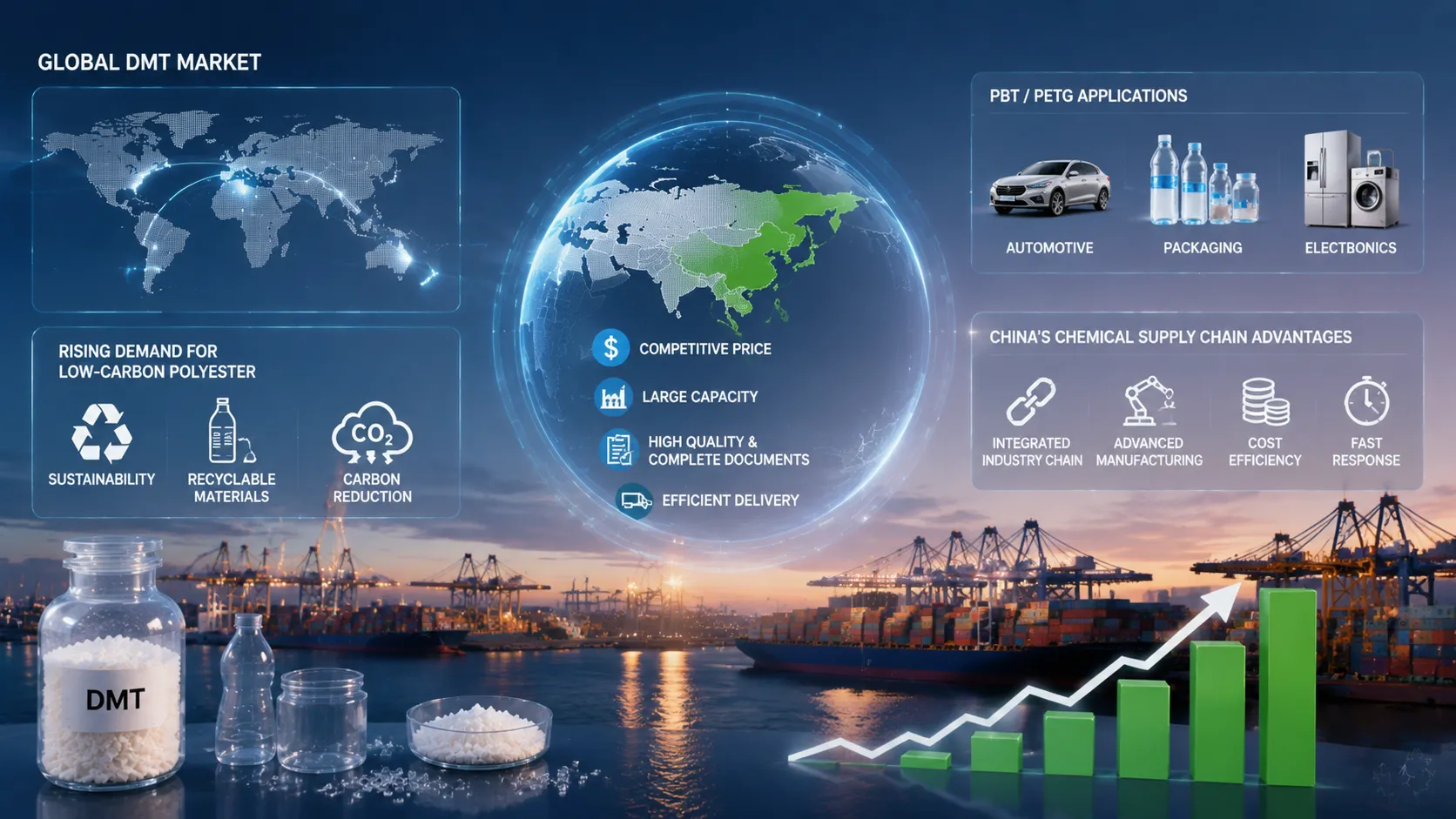 02marketMay 8, 2025
Global DMT and Low-Carbon Polyester Raw Material Competition: Opportunities for Chinese Dimethyl Terephthalate Suppliers
Analyzing global DMT, low-carbon polyester raw materials, PBT/PETG applications and China's chemical supply-chain advantages in price, capacity, quality documents and delivery efficiency.
Read more- 03marketMay 11, 2026
2026 Global Supply Chain Reshaping: DMT Market Outlook, Price Trends & China Sourcing Strategy
An in-depth analysis of the 2026 DMT global supply-demand landscape transformation — from macro market outlook, PX-DMT cost transmission mechanisms, and PTA substitution dynamics to China's integrated advantages and low-cost sourcing strategies, providing supply chain executives with a strategic and actionable intelligence guide.
Read more